Stories

Student volunteers assist veterans at Bull City Stand Down

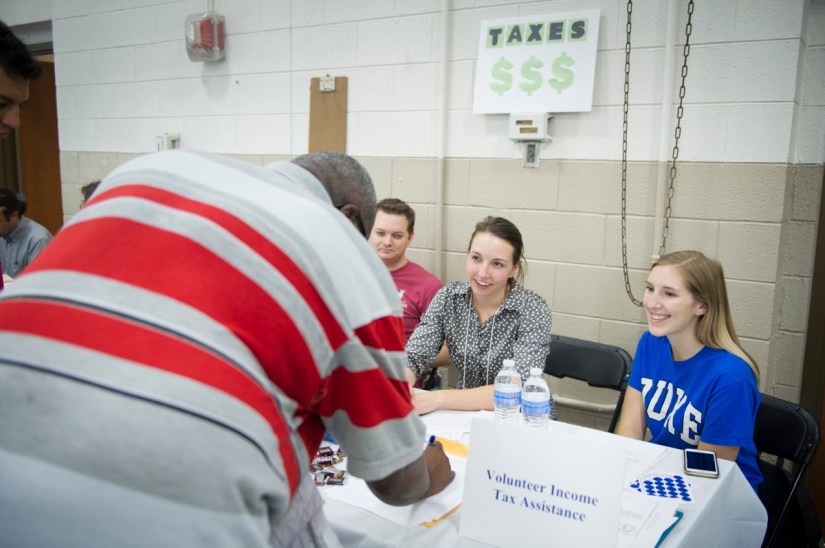
130216_bull_city_stand_down008Olivia Cole ’17 (far right) signs in an attendee interested in receiving information about Duke Law’s Veterans Assistance Project along with Hope Standeski ’17, middle, and Ric Stubbs ‘17, left.

Olivia Cole ’17 spent a recent Friday morning talking to veterans about how they might access military benefits.

She was one of 16 Duke Law students from the Veterans Assistance Project and the Volunteer Income Tax Assistance (VITA) program who attended the Bull City Stand Down on Sept. 16 to help veterans and other under-served Triangle residents with tax and benefits matters, or to update receive, or correct their military records. More than 320 veterans — many of them homeless or financially struggling — attended the annual event at Durham’s National Guard Armory to access numerous services such as eye examinations, vaccines, and haircuts, as well as legal help.

It was Cole’s third time volunteering at the Stand Down. “This event, every year, puts all of those service providers in one place and coordinates transportation to make sure that a lot of veterans can get here and get a lot of bang for their buck by being able to talk to a lot of service providers that could potentially offer them things they need but might not necessarily know about,,” said Cole, whose family’s military ties led her to join the Veterans Assistance Project as soon as she arrived at Duke Law. “
This is how the Veterans Assistance Project gets most of its clients.”

VITA volunteer Jordan Lamothe ’17 helped clients sort out an array of tax problems. “Some people haven’t filed returns for four or five years and they don’t even know where to start,” he said. “A lot of people are trying to put their lives back together after going through tough times, trying to get to a good place financially, but they’re hit with a huge tax bill and they don’t know what to do.” His goal, he said, was to help the individuals he worked with to understand their taxes and connect them to resources that can help them in the future.

“We don’t want them to have to worry,” he said. “If they owe large amounts, we give them information about how they can talk to the IRS to set up a payment plan so that going forward they can feel more comfortable.”

Leslie Lee, a Durham resident in need of tax assistance, said she appreciated Lamothe’s help. “I feel relieved,” she said. “It was a great service and it was free.”

Precious Sampson, who spent 10 years in the U.S. Army, asked for information about veterans’ benefits when she stopped by the Duke Law table. Recently laid off from a teaching job, she wanted to know about the services they offered. “I’ve actually never used my veterans’ benefits, so I wanted to see what was available to me at this juncture in my life.”

Director of Public Interest and Pro Bono Kim Burrucker, one of the key Stand Down organizers, helped train and supervise the student volunteers, along with Stella Boswell, assistant dean of Public Interest and Career Development. “By participating in this and similar events, students learn valuable legal and interpersonal skills while at the same time providing much needed services to our military veterans and other under-served persons.”

130216_bull_city_stand_down018Director of Public Interest and Pro Bono Kim Burrucker assists volunteers prepare lunch for attendees at the Bull City Stand Down.

Ric Stubbs ’17 focused on helping veterans clean up and access their service records at the Stand Down. “It’s the key to accessing any and all benefits,” said Stubbs, whose parents are both Navy veterans and who hopes to join the Navy JAG Corps after graduation. “We can’t solve all the world’s problems, or the access to justice gap in one go, but veterans [issues] is a pretty worthy place to start,” Stubbs said. “[These are] people who have gone above and beyond and done a lot to earn those benefits, to earn that promise.”

Stories

Anna Johns ’16

With her JD in hand and nearing the finish line on her PhD in history, Anna Johns finds it hard to believe that she once planned to study medicine.

She entered Wellesley College on a pre-med track, intending to follow her mother into medicine. But after taking her first history course, Johns decided to switch gears. “It was Bread and Salt: An Introduction to Russian History, and I was just in love,” Johns says. “I pretended to be pre-med for one more semester. I took chemistry, but I decided my heart just wasn’t in it.”

The native of Birmingham, Ala., graduated with a bachelor’s degree in history and French cultural studies in 2009, but found it impossible to land a job. “It was a terrible time to graduate from college because the U.S. economy was a mess. I felt really sheepish about moving home without a job.”

At that point, she had no interest whatsoever in the practice of law, but her father persuaded her to interview with one of his former law partners for a position at Maynard, Cooper & Gale. She was hired as a paralegal, and that position furthered her passion for research and laid the foundation for her career.

Under the mentorship of a former justice of the Alabama Supreme Court, Johns worked with a team defending the state of Alabama in a class-action lawsuit brought on behalf of public school children. The plaintiffs alleged that the state property-tax system had been put in place with a racially discriminatory intent in order to deprive black school children of an equal education. In addition to participating in drafting the state’s motion for summary judgment, Johns researched property tax laws at the state archives, looking for evidence supporting the plaintiffs’ claim of racially discriminatory intent in the drafting of the state’s property-tax laws.

“I never found it — which made me feel better about my home state — and the state won,” Johns says. But spending time mired in information about poor educational outcomes of Alabama kids, especially in the poorest counties across the state, sparked her interest in Teach For America, in spite of her longer-term plan to go to law school.

“The kids didn’t win,” she says. “I felt like the substance of what I was doing at the law firm had a lot to do with education, and that forced me to confront the extremely unequal access to a good education in America.”

Johns taught fourth and fifth grades, respectively, in San Antonio, Texas, for two years. She says she would have stayed teaching longer, had she not been admitted both to Duke Law (her first choice) and to the university’s PhD program in history (also her first choice). “It took that to tear me away from my kiddos after my second year.”

The James B. Duke Scholar spent her first year at Duke laying the groundwork for her PhD, happily “deep in the history mud.” She then took a leave of absence to focus solely on law. “It was awesome to just be a 1L,” she says. “I got to build friendships and put down roots, which I don’t think I would’ve been able to do if I had tried to do both at the same time.” That’s exactly what she has done for the past yearand- a-half. “Each semester was the craziest semester I’d ever had, only to be topped by the semester that was coming just down the line,” she says of juggling course loads and extracurriculars for both programs. At Duke Law Johns has served as president of the Moot Court Board, articles editor for Duke Law Journal, and co-president of the Volunteer Income Tax Assistance program, which prepares tax returns for low-income Durham residents.

Duke University’s Bass Connections initiative allowed Johns to advance her interdisciplinary interests by serving as graduate student co-chair for the initiative’s Student Advisory Council and working on a project examining retrospective regulatory review headed by Associate Professor of History and Public Policy Edward Balleisen. She also served as as Balleisen’s teaching assistant for his class, The Modern Regulatory State. Balleisen, Duke’s vice provost for Interdisciplinary Studies, says he admires Johns’ poise, maturity, and ability to apply her teaching background in structuring group activities for undergraduates. “She’s unbelievably articulate, has very wide interests, and has the ability to make connections across very different domains,” he says. “She’s taken on two grueling, challenging fields of study. I’ve seen her assimilate those two different bodies of knowledge.”

Johns says she began to appreciate and was able to better understand just how those different bodies of knowledge connect during her second year of law school when she took both an international law course with Laurence Helfer, the Harry R. Chadwick, Sr. Professor of Law, and a graduate-level course on regulation and political economy. At one point, discussion in both classes turned to the collapse of a commercial building in Bangladesh. “In Professor Helfer’s class, we were talking about international trade flows and, in the wake of the Rana Plaza disaster, corporate actions that try to address worker safety issues in Bangladeshi factories,” she recalls. “And then in my history class we were talking broadly about corporate involvement in creating public policy. I started seeing all of these connections between the two different programs. The approaches are different, but the problems are similar.”

She is highlighting those connections in her PhD dissertation, which expands on an independent study with Professor Thomas Metzloff on the history of consumer class actions and how they have been used as tools for consumer protection. After spending the summer of 2016 as a summer associate for Williams & Connolly in Washington, D.C., Johns will return to Duke “writing with ferocity” to finish her PhD. Johns will then clerk first for Judge Allyson Duncan ’75 on the U.S. Court of Appeals for the Fourth Circuit in Raleigh and then for Judge John D. Bates of the U.S. District Court for the District of Columbia.

Stories

Making connections: 1L Blueprint for Success

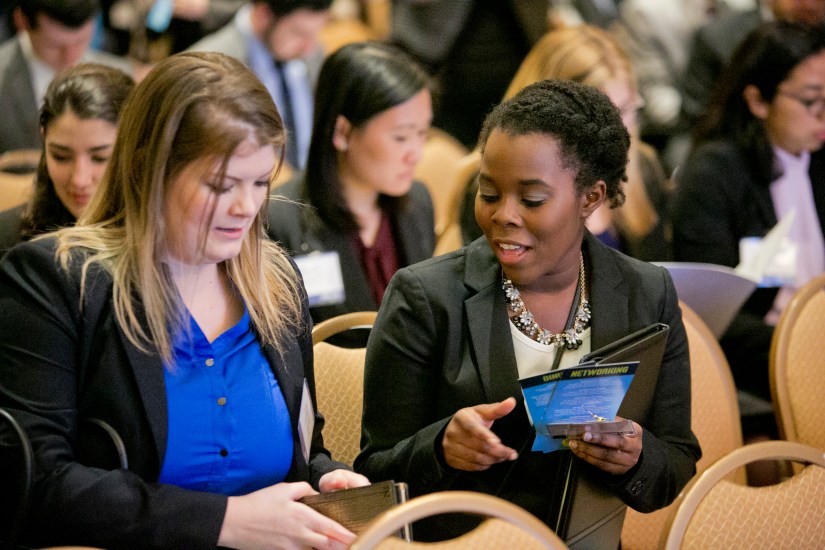
029116_blueprint_success013First-year students got a headstart on planning their careers with the annual 1L Blueprint for Success event sponsored by the Career & Professional Development Center (CPDC). More than 200 students and over 100 employers gathered at the Durham Convention Center for the March 22 event.
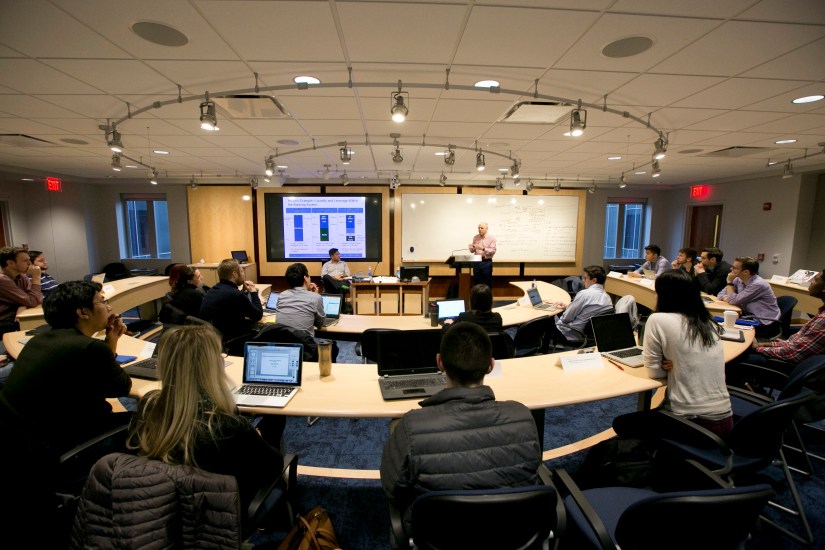
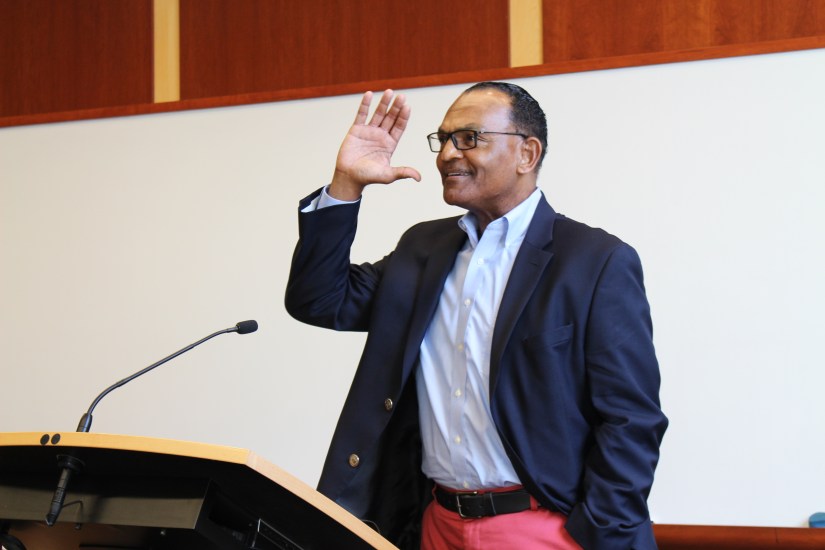
Students received a crash course on business etiquette and networking from Mary Crane, author of the “100 Things You Need to Know” book series. Crane’s advice ranged from which hand to keep one’s drink in (the left so you can shake hands with your right) to how to establish meaningful relationships with colleagues (get to know co-workers over lunch, or demonstrate an ability to play well with others by joining the office softball team).

Afterwards, students funneled into the main event space and where they were greeted by prospective employers, received business cards, and asked questions about the organizations and practice areas.

The 58 firms and organizations represented at Blueprint included first-time participant, Morrison & Foerster LLP.

“I think it’s really important for the students to get to learn a little bit more about all of the law firms that are going to be on campus in the fall,” said Kai Wilson, attorney recruiting manager for the Washington, D.C. and Virginia offices of Morrison & Foerster. “By talking to the attorneys and recruiters from the various law firms, they can kind of get a feel for the culture, practice areas, and fit and to see if they think they’d be interested in signing up. During fall recruiting, there’s such a limited number of firms that they’ll be able to meet with, so it’s good for them to be able to narrow their choices down.”

Attending Blueprint helped Sara Faber ’18 do just that. Faber, who will spend her 1L summer in Miami at the ACLU of Florida, had the opportunity to connect with a Duke Law graduate in a civil rights organization who does the kind of work she hopes to do after graduation.

“Upon hearing what I want to do and where I want to do it, she immediately put me in touch with someone in Miami,” Faber said. “It was such a generous thing to do for someone she’d just met.” Connecting with attorneys to learn more about their organizations and how to find work was also helpful, Faber said. “They were very open with us.”

Sonia Williams Murphy, counsel at White & Case LLP in Washington, D.C., attended Blueprint for the first time this year. “I thought it was a fantastic networking opportunity for students and employers alike,” she said. “The fact that the employers get to network with one another is an added bonus and makes this event a bit unique.”

Wolfgang Ettengruber LLM ’15 also noted the importance of reaching out to first-year students. The research assistant from the Clifford Chance office in Frankfurt said, “I think it’s good to meet the students early on, get to know them, kind of follow them, and establish a relationship with them to see where they’re going. I think a lot of them can make use of mentoring, just having an idea of what you’re working towards can kind of help you understand how the law firm – that big pond – works.”

Fortunately through Blueprint, students had the opportunity to start establishing those relationships with alums. “I found it really helpful and comforting that a lot of the employers were Duke Law grads,” said Faber. “They were approachable and kind, and it was helpful to have some shared experiences with potential employers.”

For more information on the Career Center’s 1L Blueprint for Success event, including sponsors and participants, please visit https://law.duke.edu/career/blueprint/.

Stories

Preparing for practice: Wintersession 2016

001316_wintersession_0004Four hundred and sixty students spent the last few days of their winter break honing their practical skills during the Law School’s sixth annual Wintersession.
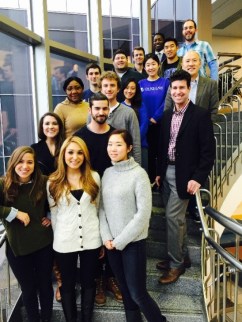
During four days of classes taught by faculty and practitioners – including many alumni – students received hands-on instruction in such areas as litigation strategy, international transactions, investing, and negotiating.

Ron Aizen ’05, counsel at Davis Polk & Wardwell, offered students an introduction to executive compensation in his course of the same name. He focused on the substance of executive compensation law, such as taxes and securities during the first half of the course. During the second half, students participated in a mock negotiation of a CEO employment agreement.

“In addition to giving the students a taste of what an executive compensation attorneys do, I wanted them to gain an appreciation of the distinction between litigation and transactional practice,” said Aizen. “I think it’s one of the most significant decisions that they’ll need to make.”

Partnering on a Wintersession course for the fifth time with Practice and Strategic Development of International Transactions: Investment in Latin America, Stuart Berkson and Jose Meirelles taught students how to take a transaction from start to finish.

Gibbs, who hopes to go on to corporate law after graduation, said Rhee also discussed the importance of developing “soft” skills. “James reminded us that relationships are critical to social and professional satisfaction –that by being open and pleasant to one another, we create happier and more productive environments.”

Stories

Wintersession 2015: Learning, building, and discovering new skills

wintersession 2015Over 400 Duke Law students spent the last few days of their winter break sharpening their practical lawyering skills during the Law School’s fifth annual Wintersession.


During four days of classes taught by faculty and practitioners – including many alumni – students got hands-on instruction in such areas as deposition strategy, drafting discovery requests and motions, and the intellectual property concerns specific to video game creation.

Milan Prodanovic ’16 took a class on the roles and responsibilities of in-house counsel taught by two Atlanta-based alumni: Allen Nelson ’89, executive vice president, general counsel, corporate secretary, and chief administrative officer at Crawford & Company, and Gray McCalley ’79, vice president and general counsel of Printpack Inc., and a member of the Law School’s extended faculty. Prodanovic said the instructors provided first-hand insight into the issues and challenges they face as corporate counsel. “I walked away from the course with a deeper appreciation of the overlap between business and legal issues that general counsels tackle on a daily basis,” he said.

Eugene Lao JD/LLM ’95, vice president and deputy general counsel at DocuSign, taught Lawyering Inside a Global Technology Company along with Michael Samway JD/LLM ’96, the former vice president and deputy general counsel at Yahoo!, where he led the international team.

“I wanted to share with students what I wish I would have known when I was in law school,” said Lao. Wintersession builds on the “great theoretical foundation” students receive at Duke Law, he said, by giving them the time to delve into subjects and skills that will make the difference between just “knowing the law and being a good lawyer.”

Ryan Berger ’17 enjoyed a course designed to offer 1Ls an introduction to the vocabulary and the process of commercial transactions, The Counselor and the Client: The Corporate Context. “The class helped synthesize the business skills I had previously as a finance major in college and skills I have developed in law school to apply them in a corporate law setting,” he said.

Berger looks forward to attending Wintersession as a 2L and recommends it highly. “It allows you to branch out and learn new things and to possibly develop new interests or discover new career paths.”

Stories

Duke Law students organize “die-in”

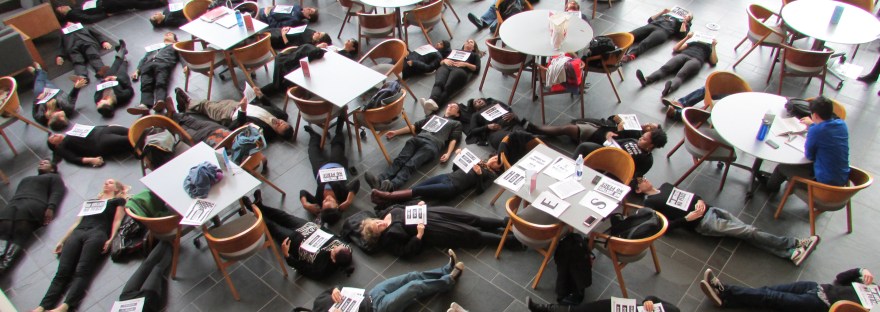
More than 60 members of the Duke Law community held a “die-in” in Star Commons on Dec. 10 to peaceably protest the death of New York resident Eric Garner and other unarmed black and minority individuals killed by police officers in recent years. Holding signs bearing the names of men and women killed, participants, including students, faculty, and staff, laid on the floor in silence for 11 minutes — one minute for each time Garner told police he couldn’t breathe as they continued to forcibly restrain him.

“It’s not like we’re making it up. It’s a real thing that’s happening, so we can’t not talk about it,” said Judea Davis JD/MA ’15, one of the student organizers of the event.

Javon Johnson’s poem, “‘cuz he’s black,” Lauryn Hill’s “Black Rage,” and audio from Garner’s encounter with police on Staten Island, followed by abrupt silence, played over the loud speaker during the demonstration.

Mark Horosko ’15 said the die-in indicated that the Duke Law community is “paying attention” to the deaths of unarmed minority citizens. “We know what’s going on, and we don’t like what’s happening,” he said.

IMG_1834

Continuing the conversation

Davis, who organized the die-in along with 3Ls Gordon Summers, Jana Kovich, and Sarah Tishler, and 2Ls Christine Kim, ’15, Liz Wan’gu, Ana Apostoleris, Peter Lettney, Nichole Davis, and Chris Hood, is planning a panel discussion in the spring semester in order to

keep the dialogue going at Duke Law and beyond. Davis hopes events like this will affirm the Law School’s position within the community as an open forum for discussing social problems. “The students that I’ve talked to believe it’s important to get the community to come to the Law School, because this is ‘our turf’,” she said. “We need to find leaders who are invested in the community — lawyers, police chiefs, and representatives of law enforcement — to sit down to continue to talk about these issues.”

The Black Law Students Association and the Center on Law Race and Politics hosted a September panel discussion on police brutality and race following the shooting of Michael Brown in Ferguson, Mo.

Davis, who is pursuing a master’s degree in history along with her JD, believes in educating others to bring about positive change.

“In America, we don’t do a good job of acknowledging our history or knowing what our history is,” she said. “The Civil Rights movement was hugely successful, but it didn’t erase all the stigmas and assumptions about black people. I think it’s great that President Obama is taking about body cameras, law schools are sending open letters of support to our attorney general and our president, and people are still doing demonstrations. I hope this means the momentum will last.”

Stories

Learning to navigate the world of entrepreneurship: Students hope LLMLE program helps launch their careers

Nicole Simpson says Duke Law’s “startup boot camp” forced her to think like an entrepreneur.

Simpson, who received her JD last May from Temple University’s James E. Beasley School of Law, is one of 17 attorneys pursuing Duke’s LLM in Law and Entrepreneurship (LLMLE).

“We basically went through the same process, in a very condensed version that startups at the American Underground go through,” she said, referring to the downtown Durham incubator for early-stage ventures. “The process helped me conceive of what being an attorney for a startup company would be like.”

Simpson and her classmates spent their first week of the fall semester learning how to craft goals and propose action plans. Working in teams, students used a strategic planning tool, The Business Model Canvas, to draw up ideas for potential key partners, resources, and revenue streams for their startups.

The group has since been immersed in coursework detailing the ins and outs of business strategy, financing, and advising entrepreneurial clients, among other subjects. That’s allowed Simpson to further hone her career aspirations; she plans to pursue entertainment or business law with a focus on mergers and acquisitions or venture capital. She says she appreciates being pushed by Professor Kip Frey ’85, who directs the LLMLE program, to set specific goals.

“He said he didn’t want the program to be just another year of law school,” says Simpson. “I’ve found that to be true.  It’s not at all like the Socratic classroom method of law school. And I learn best through experience – I can’t wait for the spring practicum.” All LLMLE candidates work directly in or for a startup or related operation such as a venture-capital firm, government agency, or law firm in the program’s second semester.

The opportunity to gain experience in the practical aspects of corporate law is also what piqued Will O’Brien’s interest in the LLMLE as he was completing his JD studies at the Chicago-Kent College of Law.

“Through the program I’ve had opportunities to talk with people in the Startup Factory,” he says, referring to another incubator where entrepreneurs can access seed money and mentorship. “Just meeting and hearing about everything other entrepreneurs are doing and coming up with plans and ideas to help them is exciting. It’s really cool to see all of these growing companies and to be around that kind of energy.” It’s also experience that will serve him well when he returns to Chicago to launch a media startup geared toward millennials.

For EJ Johnson, who plans to practice corporate law in New York following his Duke graduation, brainstorming with his classmates is as much an LLMLE highlight as the rigorous coursework.

“They’re what make this class so much fun,” says Johnson, who received his JD in 2013 from Michigan State University, where he also played football as an undergraduate. “Everyone’s not cut from the same quilt. One of my classmates also has his MBA – he’s already started successful businesses. You just learn so much from everyone’s backgrounds. Everyone has an opinion and that always makes for a lively discussion.”

Bryan McGann is the business owner Johnson mentioned. In addition to an MBA from Campbell University, a JD from the University of North Carolina at Chapel Hill, and a PhD from Walden University, he brings a wealth of practical experience to his LLMLE studies:  He is a senior attorney and litigator at Smith Anderson in Raleigh and has achieved entrepreneurial success as the creator of Pill Pockets a pet treat designed to aid medicine delivery. And along with other business ventures, McGann has recently launched a startup focused on developing his recently patented orthopedic brace for post-surgical patients who will benefit from remaining upright in bed.

For McGann, obtaining an LLM in Law and Entrepreneurship at Duke represents his commitment to lifelong learning.

“Being a lawyer is something special, and to be associated with such a great law firm is an honor. Being an entrepreneur is also something special and tremendously gratifying,” he says. “The opportunity to come to Duke and study law and entrepreneurship under this accomplished faculty has rekindled my interest in one day teaching these subjects. My classmates will use their Duke LLMLE to vault themselves into prestigious positions in law and entrepreneurship, but I’m kind of doing it the other way around. In my career, I have been blessed with many opportunities to gain practical experience, and now with the LLMLE from Duke, I look forward to the next challenge, whether in law, teaching, or perhaps politics.”