Social Media

#DukeLawLife: Planning a student takeover week

Once the Law School established its Instagram page and a respectable following, I decided to test the waters with our first big campaign — a student takeover week. My supervisor had talked about how other schools were following students around with cameras and recording “day in the life” content and expressed interest in us doing the same. At the time, social media was a secondary part of my job (I was just the office clerk) so I didn’t have the bandwidth to spend a whole day recording someone and then another whole day editing and producing the video. Putting the camera in the hands of our (very, very carefully selected) students created a much more authentic feel and gave the student community a sense ownership of the account. When I started the account, I wanted it to be a genuine reflection of student life and their experience, so it only made sense to let them take the wheel every once in a while.

Logistically, hosting a takeover isn’t that difficult, but it does require advance planning. Here’s a quick outline to help you get started.

  1. Pick your takeover participants or announce that you’re looking for participants. I picked participants the first few years. This past spring, I didn’t have time to pick anyone (re: last month of wedding planning) so I posted in the IG Story asking for participants. I received so many responses that I actually extended the takeover week to two weeks.
  2. Let the participants pick the day they want to takeover. They will understandably want to pick a busier day on their calendar to show off for The ‘Gram.
  3. Send participants the takeover rules. SEND RULES. Don’t skip out on this step. You don’t want to have to deal with the “well, you didn’t tell me I couldn’t post that” conversation after something inappropriate has been posted to your institutional account >.<
  4. Let your followers know what’s happening. Remember to post that the takeover is happening so that they know to look out for it. I would post on Friday night to let our followers know that the takeover was going to start on Monday. Then, on Sunday night, I’d post a photo of the first participant so they knew who they were “following” that day. I’d repeat this process throughout the week with each participant’s photo.
  5. Monitor, monitor, monitor. Keep a vigilant eye on what your participants are posting to mitigate any inappropriate posts. At the end of my rules sheet, I always let the participants know that I can (and will) remove anything that doesn’t abide by the university’s standards.

Once it’s all over, take a deep breath! The takeover week will fly by. If you ended up getting some great content, be sure to save it to your Highlights. In the past couple of years of running our takeover through IG Stories, our students have really surpassed our expectations for content. One student started a Q&A with her classmates and other student participants followed suit. I ended up saving those clips as its own highlight separate from the takeover reel.

How do you feel about takeover campaigns? Let me know in the comments —

Social Media

Virtual Reality Day

Duke OIT and the Law School’s Media Services department hosted a Virtual Reality Day to introduce the community to its uses in the legal field (and some fun games!) Since I had some time to plan ahead, I put together a short IG story to drum up some excitement and let people know what was happening throughout the building.

IMG_3630.png

A03D0A2C-A9E2-4E3A-9E0C-A25328D1B0DB

Social Media

Finch release

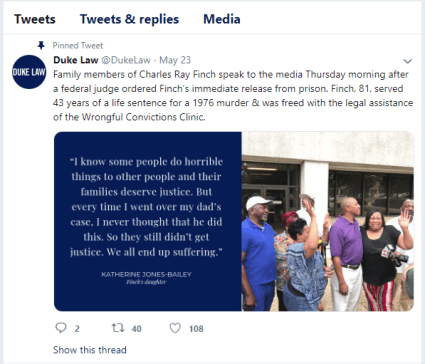
Every so often justice gets served in a big way…a really, really big way. Charles Ray Finch was released from prison after 43 years for a murder he didn’t commit. Our faculty and students worked tirelessly to secure his release. Their perseverance was inspiring and reminds me why I enjoy working at this institution. You can read more about Finch, the Wrongful Convictions Clinic, and their work on his case here.

finch release 1

Our senior writer attended the hearing and was able to capture quotes and photos with her phone. Once she was back in the office, we worked together on how best to share the information on social media. Since this was such a huge deal and she had multiple photos and quotes, I suggested that we post a Twitter thread instead of a single tweet to really tell the story. To stay within our character limit, I put the quotes on the Twitter cards and used the rest of the text in the tweet. The result was a four-part thread that included quotes from Finch’s daughter, the clinic co-director, and one of the students who worked on the case. I pinned the tweet to the top of the page to get maximum exposure.

finch release 2

I took a similar approach to Facebook. I asked our writer to sum up the hearing with a pithy nut graph to use as the post text, and then I used the text from the tweets to caption the individual photos. The character counts on Facebook aren’t as restrictive as Twitter, so I didn’t feel the need to create graphics and let the photos stand on their own.

The last element to this social media blast was Instagram. I posted a five-card story and a post in our feed which prompted readers to check out our story to read the full article on our website. The Instagram story fell into place at the perfect time. I was about add a CTA to link to a local news story, but our writer had finished her piece right as I was looking for something to link to! ::wipes sweat from brow::


In short: we got alotta eyeballs on our posts, alotta swipe ups, alotta likes/loves/shares, and congratulatory comments. It was a great day.

Social Media

Branded Insta-Stories

Several of the brands I follow on Instagram have really mastered how to maximize their followers’ micro-moments. For example, all of the wedding sites I follow (can you tell I’m in the midst of planning?) feature the top stories of the day in their Instagram stories. They even re-share older stories that they’ve included in their emailed newsletters and posted on their other social sites. Some of these stories are months or even a year old, but sharing them in a freshly designed Instagram Stories format makes them new again.

Following in the footsteps of my fav brands, I decided to create a “Today @ Duke Law” template that features what’s happening in the Law School that day.  It’s a pretty simple template: I start the campaign with the Today @ Duke Law card to let viewers know what the corresponding slides will be about. I’ve left space underneath the Duke Law logo to write in today’s date natively through Instagram. On the following slides, I include a cute little graphic that corresponds with the event along with the event title and a CTA at the bottom directing viewers to swipe up to see the full event description on our calendar.

In order for this campaign to be effective, I have to post as soon as I wake up since sometimes we have events that start before I get to the office. There’s also a lot of prep work that goes into this campaign. All of the designs and website links have to be created and curated in advance to avoid potential mishaps. Asana has been a huge help with organizing my branded Insta-Story campaigns. Once I’ve finished designing my collateral in Canva, I pop everything into a card, set a due date, and I’m ready to go. During our first week, I received several compliments – from colleagues stopping me in the hallway to DMs from students.

Given the success of the Today @ Duke Law posts, I’ve decided to venture out into more branded content. After the election, several of our alumni won offices and my colleague put together a piece about each of them. The first slide directed viewers to the entire article and the subsequent slides featured each alum with a short blurb about them and a CTA to visit their campaign websites.

Right now our Insta-Stories have a 3-4% engagement rate. I’m interested to see how our engagement and impressions will be impacted with this new branded content.