Stories

Duke Pre-Law Undergraduate Scholars discuss program’s networking, experiential learning opportunities

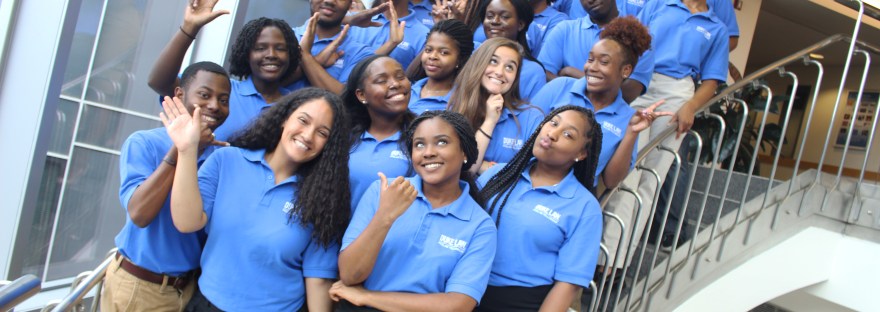
Sarah Pierre, a criminal justice major from Alcorn State, a historically black university in Mississippi, spent four weeks last summer at Duke Law taking classes in legal writing and analysis, criminal law, and LSAT preparation, alongside 21 other rising juniors from Southeastern colleges and universities. Enrolling in the Law School’s Pre-Law Undergraduate Scholars (PLUS) Program was a key step, she said, towards realizing a goal she has had since she was four years old: to someday become a judge.

Pierre was among the second cohort of PreLaw Fellows in the PLUS Program. With the assistance of a three-year, $300,000 grant from the Law School Admission Council (LSAC), the PreLaw Fellowship expanded from a two- to a four-week residential program designed to help students gain insight into the demands of law school, the application process, and what a career in law might look like. Students also had the opportunity to connect with alumni, judges from the Bolch Judicial Institute’s Master of Judicial Studies Program, admissions deans from other law schools, lawyers, politicians, and criminal justice reform advocates.

“One of the most effective aspects of the program was introducing the students to legal professionals who looked like them or who had similar backgrounds,” said Director of Diversity Initiatives Ebony Bryant, who oversees the PLUS Program. “The students are able to envision themselves as judges, arguing before the court, or as lawyers doing complex transactional law.”

For Pierre, meeting an African American judge helped her realize that “black success in law isn’t as far of a reach” as she thought it was. “It’s nice to see people who have already broken barriers,” she said.

Elvis Mugisha, a political science major from North Carolina State University, also benefited from meaningful connections he was able to make with Law School faculty. At the conclusion of the program, he spent the next two months as an intern in the Wrongful Convictions Clinic, working with Duke Law students on cases pertaining to prisoners’ claims of actual innocence under the supervision of Theresa Newman, the Charles S. Rhyne Clinical Professor of Law and clinic co-director, and other faculty members.

“I could see how diligently they worked,” said Mugisha, who plans to attend law school and earn a dual degree in either business or public administration. “I could see how passionate they are about helping people.

“This program helped me realize that law is right for me,” he added. “The pay-off will be greater than anything you can do before applying to law school.”

Jordan Davis, an English major from Morehouse College in Atlanta, got a similar recommendation from a friend at Spelman College who was in the PLUS Program’s inaugural 2017 class of prelaw fellows. Getting first-hand experience of what law school will be like and insights into applying are particularly important, he said, for minority and first-generation students who don’t have parents or family members who have done so previously. Davis, who will join Teach for America after his Morehouse graduation, plans to get a JD before embarking on a career in educational policy. “I’m all about lifting as we climb,” he said.

After completing the PLUS Program, Pierre started the Alcorn Pre-Law Society. “Ever since I’ve gotten back from Duke, my desire to help others has increased,” she said. “I’ve witnessed seniors going through the law school application process at the last minute and I don’t want others to have to go through that.” She hopes to grow her current membership of 30 Alcorn students into a network of pre-law students throughout the state of Mississippi. And she definitely plans to apply to law school: “I want to be an advocate for those who can’t advocate for themselves.”

Applications for the 2019 PLUS Program, which will be held at Duke Law June 2 to 28, are due March 15.


Stories

Marcus Benning ’17

As a Duke undergraduate, Marcus Benning, who served both as  president of the Black Student Alliance and senate president pro-tempore for the Student Government, was instrumental in establishing a new student social housing group focused on black culture. Now, as president of the Black Law Students Association (BLSA) and as a LEAD fellow, he is helping lead the diversity and inclusion effort at Duke Law.

“I really love Duke,” says Benning. “But my relationship with Duke is complicated, because I want to change so many things about it.”

Attending “Common Ground,” a student-led retreat organized by the Duke Center for Race Relations early in his sophomore year was a pivotal experience for Benning, who majored in history and linguistics. It helped him understand, he says, the experiences of diverse minority groups on campus, and laid the foundation for many of his leadership activities. “We spent three days talking about race, gender, and sexual orientation. We argued and cried and figured it out together. It kind of changed my life.”

Benning, a native of Atlanta, credits his mother with sparking his passion for community engagement and social justice. She also made sure he had people in his life “who would mentor me in ways she could not,” like his high school band director, who Benning says taught him the importance of punctuality, respect, hard work, and perseverance through music. Shortly after arriving at Duke he found two more mentors at the Mary Lou Williams Center for Black Culture: Director Chandra Guinn and Assistant Director Sean Palmer. They were instrumental, he says, in his development as a leader and as a scholar.

Guinn says Benning’s personality was evident from the first day she met him. “He had very strong opinions, a willingness to share them, and a willingness to have his mind changed,” she says. “He is a young man with a desire to see other people excel along with him.”

Benning got started on doing that when he secured a $500 award from a Duke University think-tank during his freshman year to launch the Duke Connects Challenge, an effort to build ties between Duke students and Durham residents. He invited his classmates to submit proposals for projects that would benefit the city, as measured by their sustainability, affordability, and community impact.

“From talking to other students, I learned about lingering tensions between Duke and Durham,” he says of his motivation for the challenge. “I got the impression they were exacerbated by the lacrosse incident and were never completely resolved.” The winning challenge proposal, submitted by residents of Randolph Hall on East Campus, engaged students in cleaning up and improving public parks.

As a sophomore, Benning worked successfully to establish a new academic and social housing group at Duke for students interested in immersing themselves in black cultural awareness and academic engagement. Open to students of all races and ethnicities, the Black Culture Living Group on Central Campus houses 22 students and works closely with the African and African American Studies Department and the Mary Lou Williams Center to host educational events and discussions relating to the diversity of the African Diaspora.

“This group is particularly important as social justice campaigns such as Black Lives Matter take shape,” he says. “Hopefully students who have lived in the Black Culture Living Group and others like it will launch movements of their own to tackle the injustices they experience.”

Aiming for a career in corporate law, Benning decided that Duke remained a good fit for law school academically, and that his work on campus wasn’t finished. Active in BLSA as a 1L representative, he is pleased, now as president, to be partnering with “seven other talented, determined second-year students” on the executive board. “Because BLSA’s board is so diverse — they bring experience from a variety of industries, including education and energy, and have lived and traveled all over the U.S. and around the world — our initiatives and events will naturally capture a wide range of perspectives and reach broad audiences.”

In September, Benning served as both a host and panelist at a community discussion of the works of Harper Lee that attracted students and faculty from across campus. Framing the conversation as an exploration of idealism and personal responsibility to enact positive social change, he challenged his fellow students to “reimagine Duke and reimagine the world to seek and expect the best of this place, and to thrust that vision into reality with our activism.” He drew a parallel between the falsely accused character of Tom Robinson in To Kill a Mockingbird, and the unarmed black men whose deaths sparked the Black Lives Matter movement.

“The story isn’t new, and neither is our responsibility as future lawyers and scholars of all disciplines to determine our role in reimagining the world as a just and equal place,” he said.

“One of the beautiful things about Marcus,” says Sean Palmer, one of Benning’s undergraduate mentors, “is that he left undergrad with an agile mind that I think is being empowered at the Law School.”

One of BLSA’s top priorities for the current academic year is addressing the discomfort students of color sometimes feel with the way race is handled in the classroom. As an example, Benning cites his own discomfort when one classroom video on dealing with difficult negotiators featured the cultural cliché of “an angry black woman” to make the point. “In the 21st century, racism is not about people’s intent, but about the impact of what they do and the signals that you’re sending,” he says.

BLSA recently surveyed black students about their experiences at Duke Law in class and out, and is working to compile the data into a comprehensive report with concrete recommendations for the dean.

Benning, who interned at Burr & Forman in Birmingham, Ala., and Smith Moore Leatherwood in Raleigh over his 1L summer, intends to spend much of his last two years at Duke advocating for increasing university funding for “the Mary Lou,” the organization that helped nurture his leadership skills and his activism. “The whole purpose of me being here is to shake stuff up,” he says. “There’s no reason why this place should be the same way it was when we got here.”

Stories

Doedens, Blank, and Hogue ’15 present Capstone Projects

Joline Doedens, Karlee Blank, and Madeleine Hogue, all members of the Class of 2015, made presentations to the faculty last month as part of the final requirement for completing their third-year capstone projects.

Often interdisciplinary in nature, capstone projects are selected and designed by students based on their academic and professional interests. Students are required to present their projects, which can take the form of a scholarly article, model bill, or other work product, to the Capstone Year Committee.

Professor Kathryn Bradley, who administers the program, says participating in a capstone is ideal for students who want to explore interests that go beyond what is discussed in the classroom or build on the experience they’ve gained in the workplace or in law school. “A capstone project can be a perfect way to bring things together, often resulting in publishable work or in a deliverable that has practical use to laypersons or lawyers,” she said.

Building off of the research and interviews with local judges she undertook for capstone research paper, Doedens wrote a guidebook to equip victims of domestic violence and practitioners with the knowhow to obtain a protective order and access other resources related to their situation.

Professor Charles Holton '73, director of the Civil Justice Clinic, with Joline Doedens '15Professor Charles Holton ’73, director of the Civil Justice Clinic, with Joline Doedens ’15

“I learned from working with clients in the Civil Justice Clinic that clients often have no idea about how the court systems work,” Doedens said. “They are terrified something bad will happen.”

Doedens researched the differences in how domestic violence cases are handled in seven North Carolina counties and compared their current practices to the best practices suggested by the North Carolina Administrative Office of the Courts (NCAOC). She discovered that a lack of resources, especially in rural counties, coupled with victims who did not fully understanding their options and rights resulted in lopsided legal representation as well as inconsistencies in practices.

For example, courtroom safety and security standards vary widely in the seven counties. “Defendants often walk across the courtroom to their bench unaccompanied. Even though they are shackled and handcuffed, they can still attempt to get away or distress the victim,” she said during her presentation.

Although some courts may not be able to have extra bailiffs in the courtroom, as suggested by the NCAOC, Doedens believes following the other guidelines – such as arranging separate exits and entrances for plaintiffs and defendants, making sure plaintiffs and defendants sit on opposite sides of the courtroom, and ensuring both parties respect courtroom etiquette – will help to create a safer environment.

She plans to distribute brochures and flyers promoting the online version of the guide in grocery stores and women’s shelters.

Blank focused her capstone project on issues American lawyers confront when collaborating with foreign law firms that represent American clients.

“My professional interest in the interplay between American attorneys and local foreign counsel evolved into an academic interest through Professor Bradley’s Ethics course and Professor [Bruce] Elvin’s class on the Business and Economics of Law Firms,” she said. “That class introduced interesting questions about the ABA’s Ethics 20/20 work as well as the future of globalized law firms, the logistics of managing offices overseas, and the challenges presented by legal outsourcing.”

Karlee Blank '15Karlee Blank ’15

An independent study Blank completed in the spring semester of her second year on the ethical implications of working with lawyers in civil-law systems in Angola, Mongolia, and Venezuela served as the foundation of her capstone project. “I wanted to take this research a few steps further and identify practical mechanisms for reducing the risks when collaborating with such counsel,” she said.

Blank’s Risk Mitigation Manual: Transnational Legal Collaborations, describes mechanisms American law firms can use to assess and “effectively mitigate the inherent risks” involved in working with foreign counsel. Her accompanying methodology paper identifies challenges American law firms may overlook before entering into transnational representation such as socioeconomic, cultural, and political differences, and logistical barriers like time differences between the two countries or the difficulty of finding a competent translator.

Blank said she feels encouraged by the positive feedback she’s received from legal professionals in and outside of the Law School. She plans to continue to refine her project and Risk Mitigation Manual after graduation. “After publishing the Manual,” Blank said, “I plan to develop a course or webinar series on the best practices for successful transnational collaboration.”

For her project, Hogue engaged with the question of why juveniles waive their appellate rights at a higher rate than adult criminal defendants. Her paper incorporates interviews with practitioners in the juvenile justice system and explores a variety of topics, including what role attorneys play in the decision to appeal, and whether children’s best interests or expressed interests are taken into consideration when deciding whether to appeal. She also considered how parents and legal guardians influence the appellate process and whether the threat of shouldering court fees in the event their child loses an appeal has an impact.

Hogue presented her research during the Early Career Scholars session at the Seventh Conference on the Future of Adversarial and Inquisitorial Systems, hosted by the University of Warwick School of Law and Criminal Justice Centre. This year’s theme was “Protecting the Vulnerable Accused in Criminal Proceedings.”

Bradley said Doedens, Blank and Hogue’s work demonstrated creativity and self-initiation. “For each,” she said, “I think the work truly was a ‘capstone’ to their time at Duke Law.”

Stories

Duke Law students answer Legal Aid inquiries as “lawyers on the line”

IMG_1856She may only be midway through her first year of law school, but Ashton Garner ’17 has already helped a client reach a satisfactory settlement of a landlord-tenant dispute.
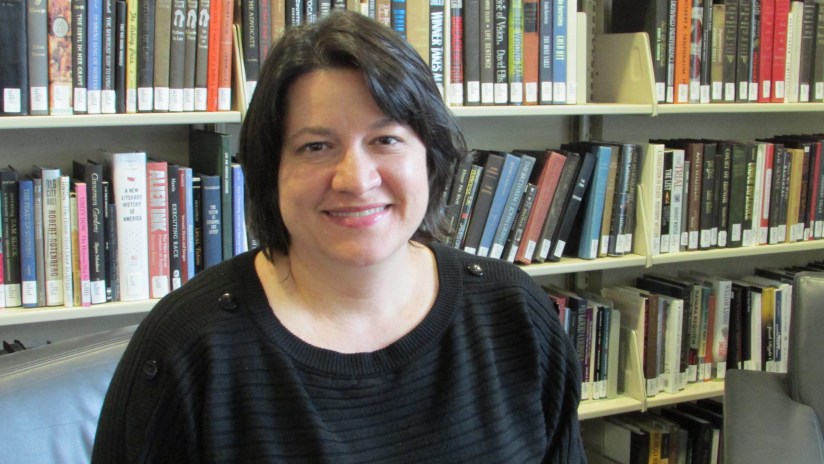
Garner serves as a volunteer “Lawyer on the Line” through a new partnership between Duke’s Office of Pro Bono and Public Interest and Legal Aid of North Carolina (LANC), which runs a broader program offering legal advice to low-income individuals by phone. Supervised by LANC attorneys, Duke Law students interview callers and research their problems, then offer concise answers to the legal questions raised. In some cases, they might write letters or craft documents on behalf of these clients.

Garner had the opportunity to put her writing and consulting skills to the test with her first client, an individual in a landlord-tenant dispute. Shortly after signing a long-term lease and moving in, Garner’s client realized the home was in serious need of repairs. Because the landlord failed to make the necessary repairs on the home, the client decided to move out, but the landlord demanded the client honor the lease. Garner said she was surprised the landlord involved in her case was so amenable to the terms outlined in the letter she wrote on behalf of her client. “I think once the landlord was presented with the applicable law, there was no way to deny it was the right thing to do. The client was very appreciative of my help, and it felt great to help someone who had been wronged get some relief.”

Garner said she was drawn to this volunteer opportunity as a way to help others and put her classroom knowledge to real-world, practical use. The Lawyer on the Line program affords the time and space for student volunteers to hone their writing and consulting skills to ensure clients feel heard and understood, she said.

“I have to be able to explain the law to the client in a simple way that is understandable to someone without a background in the law. You do not realize how challenging that can be until you try to explain legal concepts without using legal jargon!”

IMG_1857

Lawyer on the Line student director Caroline Sorensen ’16 was introduced to the program last summer when she worked as an intern at the Legal Aid Centralized Intake Unit. Sorensen spent each day on the phone providing legal advice to clients whose cases couldn’t be transferred to local LANC offices. “At the end of the summer, LANC mentioned they wanted to get Lawyer on the Line started at Duke, and I knew I wanted to help get it going,” she said.

Since the program began in January, student volunteers have assisted with nine cases ranging from employment, private landlord tenant, and consumer issues to record expunctions.

“Our students help bridge the service gap,” said Kim Bart ’02, Assistant Dean of Public Interest and Pro Bono. “This project supports Legal Aid of North Carolina’s work by expanding their pro bono reach, while providing a great opportunity for Duke Law students to develop important practice skills.”

Garner feels her involvement with Lawyer on the Line is helping her prepare for her summer internship with a law firm in Atlanta. Taking responsibility for direct client interaction has helped improve her problem-solving skills as well as her ability to relate and communicate clearly to her clients, she said.

Although the program is in its early stages, with 40 highly engaged students signed up to volunteer, the support of The North Carolina Bar Association, and guidance from LANC, Duke’s Lawyer on the Line is poised for growth. “This might be the smoothest a school has ever implemented the program in its first semester,” said David Wormald, Lawyer on the Line Coordinator at LANC. Duke Law students, he said “are completing files very quickly, but with well-written summaries that cover the depth and breadth of the matter.”

If the program continues on its current path, Duke will be assigned a second supervising attorney, which will allow students to take on additional cases and help more people in the community. “I hope to help get Duke Lawyer on the Line off to a strong start so that it may continue to benefit Duke students and the community for years to come,” Sorensen said.

Stories

The Duke PreLaw Fellowship program: Laying the groundwork for professional success

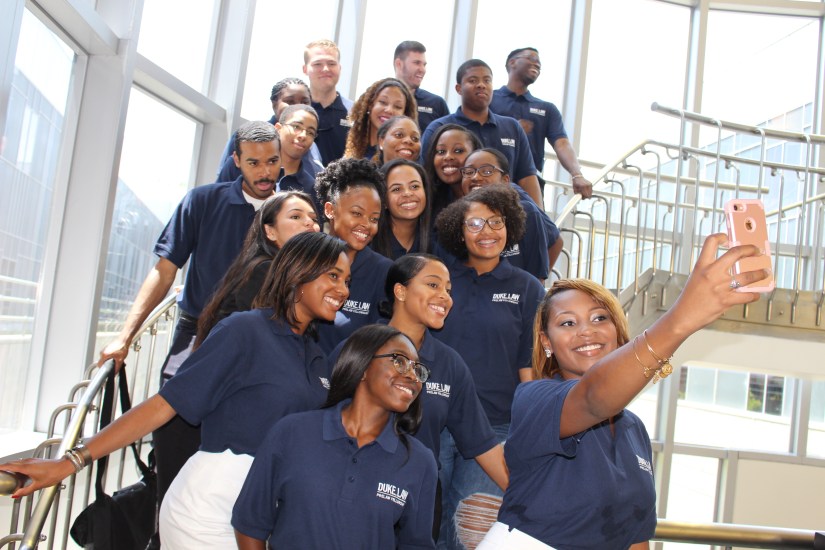
IMG_8710The Law School welcomed its first cohort of PreLaw Fellows this past June.

Twenty rising juniors from eight colleges and universities in Georgia and the Carolinas spent two weeks in residence at Duke, taking classes in criminal law, legal writing and analysis, and LSAT preparation, and gaining insight and advice on applying for and succeeding in law school.

The goal of the full-scholarship “pipeline” program is to introduce students from underrepresented communities to the rigors of law school and the benefits of having a legal education, as well as to ensure they have essential information to help them navigate the admissions process, said Ebony Bryant, director of diversity initiatives at Duke Law. “I had worked in law school admissions for 10 years and saw some of the struggles that some first-generation or minority students had in applying late or in lacking the information they needed to get into a school like Duke Law,” she said. “They often ‘come into the game’ late, so they’re too late to qualify for scholarships. They need to know at least two years out what they need to improve on, how much money to save, and which courses to take to help them with reading comprehension.

“One of my biggest professional goals is making sure students, regardless of their background, the school they went to, how they started in life, that they could go to the law school of their choice,” she said.

Admission to the program mirrored the law school application process. Applicants were selected based on transcripts, recommendation letters, Skype interviews, and writing samples. “Writing is so important to success in law school and as a lawyer,” said Bryant. “We wanted to make sure we were admitting the best students from each school.”

Students spent four days each week immersed in doctrinal courses — Criminal Law with James Coleman, the John S. Bradway Professor of the Practice of Law, and Legal Writing and Analysis with Clinical Professor Rebecca Rich. They received the same books first-year law students use for those classes and experienced similarly rigorous expectations and instruction. Each produced a capstone paper and made a presentation in Criminal Law.

“Professor Coleman gave us an assignment in which we had to pair up with another fellow and explain why a specific case decision should remain or why it should be overturned,” said Kourtney Johnson, a political science and economics major from Spelman College in Atlanta. “We had to rely on the cases that we read throughout the program in order to back up our arguments.”

“As I had hoped, the students were eager to learn, very engaged, and very opinionated!” said Coleman, who called the fellowship program “an excellent introduction” to studying the law. “I love teaching and interacting with students at the very beginning of their journey to become lawyers,” he said. “They learned that having an opinion was very different than having an informed opinion. By the end of the two weeks, they had worked hard to make sure that their still strong opinions were informed by the cases they read and our classroom discussions.”

Fridays were dedicated to LSAT preparation, professional development, and “Real Talk” sessions with Duke Law administrators. Lewis Hutchison, assistant dean for student affairs, discussed the transition from undergrad to law school, Tia Barnes ‘03, assistant dean for academic affairs, provided them with tips on how to succeed in the classroom, and Bryant offered advice on the admissions process. They also met Duke Law alumni, visited a local firm, and went on a tour of the State House of Representatives in Raleigh. “The main reason why we went to the State House was to show them this is where you could be,” Bryant said. “Part of access is allowing people to see themselves in a place.”

David Duncan, a psychology major from Elon University, said he enjoyed the opportunity to connect with legal professionals. “This glimpse into a law career was invaluable to my future success as a lawyer.”

Malik Wilson, a sociology major at Morehouse College in Atlanta, said the fellowship program gave him a clear sense of what he needs to do to achieve his goal of studying law. His “amazing” professors confirmed his interest in doing so, he added. “Professor Coleman’s level of experience and knowledge are truly unmatched making learning in his Criminal Law class an adventure every single day,” he said. “Likewise, Professor Rich’s tips and tricks regarding legal writing were invaluable.”

Bryant said she was impressed with the inaugural class of fellows. “Now they can envision what law school is and they can make a clearer decision based on the time they spent here,” she said. “That’s what it’s all about — it’s giving someone the opportunity to make a good decision.”

Stories

Jackson ’17 and Lott ’17 land Legal Honors Program positions with HUD and DOJ

Two recent Duke Law graduates will begin their careers with the federal government after navigating the highly competitive selection process for the Legal Honors Programs in two executive branch agencies. For each, gaining entrance to the highly selective program represents the culmination of years of deliberately focused study and skill-building in their respective fields of interest, as well as the support and mentorship of Duke Law career counselors and alumni. Ocoszio Jackson ’17 will enter the Department of Housing and Urban Development’s Legal Honors Program, working out of the New Orleans’ field office. Jasmin Lott ’17 was selected for the program in the Department of Justice. Both students credit their interests in public service and a desire to uplift people in need as motivation for pursuing these positions.

“The agencies look for candidates with strong legal skills and good judgment, who can add value immediately,” said Assistant Dean Stella Boswell, who directs the Office of Public Interest and Pro Bonoand advises government and public interest students and alumni through the Career Center. “They also look for students and graduates with a passion for public service and a commitment to the mission of the agency. “These students worked exceptionally hard to qualify for these positions and make it through the many steps of the application process.”

IMG_7284

Jackson said he learned of the importance of stable housing early on while living with his grandmother. He recalled there was a home across the street, which he later found out was a government subsidized home. “There were families that were constantly in and out of that home. I always wondered ‘Why do we always have new neighbors? Why do they have to leave?’” he said. “By contrast, we had a place we knew was ours, that we always went to, where we were able to take care of ourselves, were able to have a good night’s sleep — where we felt safe.”

Jackson, who majored in political science at Morehouse College, said he became interested in housing finance during the market crash. HUD came onto his radar during his second year at Duke Law when the community surrounding his alma mater — the West End of Atlanta — received a $30 million redevelopment grant. His interest in working for the office only grew after attending one of HUD’s on-campus informational sessions.

After working for GSK in Durham and the Brennan Center for Justice in Washington, D.C. during his 1L summer, Jackson spent the following summer at K&L Gates in Washington. “I had a wonderful experience there learning how a large, international law firm works,” he said, adding that it helped him to refocus his career goals. “I’m excited about starting my career doing government work and the day-to-day impact it will have.”

IMG_7346

Lott, who has a strong interest in civil rights, looks forward to returning to the Department of Justice where she held a Duke in D.C. externship last fall. She said recent conflicts between police and communities of color influenced her interest in pursuing a career in criminal justice. “It’s become an even more important issue to me personally because I’ve seen the unraveling of Ferguson,” she said. “Once I got here, I saw where the need was.”

She credits the experience gained from working in the Civil Justice and Children’s Law Clinics for helping her get practice-ready and learn how to phrase questions and dig for answers. “I’ve gotten a lot of concrete skills by actually working on cases, and frankly being able to talk about actual substantive legal work that I’ve done in interviews helped me,” she said. Lott spent her 2L summer working for both the NAACP Legal Defense & Educational Fund, where she assisted with civil rights litigation, and Neufeld Scheck & Brustin working on discovery review in civil litigation related to wrongful convictions and police misconduct.

“Just seeing how egregious some of the civil rights violations were and getting the sense that these officers felt like they were above the law was very infuriating for me, but it was powerful to feel like I was in the position to do something about it,” she said.

Stories

Gabrielle Lucero JD/MPP ’17

Gabs Lucero first learned about sexual assault as a sixth-grader in Fort Collins, Colo., when a friend told her she’d been abused. “I didn’t know what sexual abuse was, but as I learned more about it over time, I realized just how common — and how big — of a problem it was,” she recalls. That early realization sparked a resolve to aid victims of sexual assault that has given Lucero an unwavering sense of direction in her activities, education, and career plans, from her high school advocacy for awareness and prevention of sexual assault, to her decision to study law and policy at Duke, to her goal of becoming a special victims’ prosecutor in the U.S. Army JAG Corps. “I was fortunate to have had something I was really passionate about when I was pretty young,” she says.

At Columbia University, where she majored in gender studies and sociocultural anthropology, Lucero served as a campus rape crisis advocate, manning a hotline, responding to hospital calls, and accompanying victims to court. By her sophomore year, her volunteer work got her thinking about becoming a lawyer.

“I saw how the legal framework surrounding issues of sexual assault could either help or hurt them,” she says. “I hope to be on the helping side.” Around the same time, Lucero began considering a career in the Army, having been impressed by her interactions with students who were veterans or on active duty in the service. “They always seemed like people who I’d want to work with and that inspired me,” she says. They also told her about the JAG Corps. “Learning more about sexual assault and about the JAG Corps in college confirmed my decision to go to law school.”

Learning, through media coverage, that the Armed Forces were developing new policies to address the problem of sexual assault within their ranks, Lucero spotted an opportunity that, she says, married her interests: “I realized that if I started my graduate studies as new policies about sexual assault were being implemented, by the time I entered the military four years later, I’d be able to see the trickle- down effects. I would be able to see whether they were actually working.”

Lucero entered Duke University’s Army ROTC program as soon as she arrived on campus to pursue her master’s in public policy along with her JD. It has proven to be a perfect fit; in the fall semester of her third year, the seniors honored her with the ROTC Leadership Award. “It meant a lot to me that they thought I deserved that,” says Lucero, who is now the cadet battalion commander for the Duke Army ROTC Blue Devil Eagle Battalion.

She has received guidance from several faculty members with military ties, including Professor Tom Taylor at the Sanford School of Public Policy, who served as an Army attorney and in the Pentagon, and Professor and Maj. Gen. Charles Dunlap, director of the Center on Law, Ethics and National Security and a former Air Force deputy judge advocate general. Lucero credits her ROTC professor of military science, Lt. Col. Keirya Langkamp, with clarifying the privilege of being an officer. “She pushed all of us to understand the challenge and the reward of being responsible for people below you, having that kind of structure and knowing what that means,” Lucero says. “That was really inspiring and pushed me both in ROTC and elsewhere by realizing the kind of impact I could have.”

Langkamp describes Lucero as an exceptional young leader and an excellent role model of the Army’s seven values: loyalty, duty, respect, selfless service, honor, integrity, and personal courage. “She is both self-aware and regulated — poised we call it in the Army — and demonstrates a high degree of empathy,” Langkamp says. “Cadet Lucero’s emotional intelligence will serve as a force multiplier for the Army, both as a leader and a future JAG officer.” Lucero, who describes herself as “a really people- driven person,” has assumed multiple leadership positions at Duke Law, serving as director of the Coalition Against Gendered Violence, as a Mock Trial Board member, as vice president of the Government and Public Service Society, and as co-editor-in-chief of the Duke Journal of Gender Law & Policy. As co-director of the Veteran’s Assistance Project (VAP) in her second year at Duke Law, Lucero worked successfully with her classmate Sarah Williamson and Matt Wilcut, a staff attorney at Legal Aid of North Carolina and VAP supervisor, to redesign the program so that more students could be recruited and trained to effectively serve more veterans. “Gabs was tireless and committed throughout the design process and as a leader of the project,” says Wilcut, who also praised Lucero’s ingenuity in addressing client problems and her willingness to recruit and mentor volunteers. “Her personal enthusiasm and commitment has a great deal to do with the success of the project.”

Wilcut selected Lucero to handle the project’s first military sexual trauma case, saying she produced legal research that will be helpful in all similar cases. Her analysis of the issues was “spot on,” says Wilcut, and persuaded the Veterans’ Administration to reverse its earlier refusal of benefits to the client. As a leader and advocate, Wilcut adds, Lucero “has produced the greatest single-student contribution to the Veteran’s Assistance Project in terms of project sustainability and client success.”

Off campus, Lucero serves as a hospital responder for the Durham Crisis Response Center and coaches a girls’ youth basketball team at the YMCA. “It’s such a nice reminder of the world outside,” she says. “For kids at that age, having someone to listen to them makes a world of difference. All they care about is that you’re there.” Lucero, who received the 2015 Sarah Parker Scholarship Award from the North Carolina Association of Women Attorneys, was honored with the National Association for Law Placement’s Pro Bono Publico Award in October. “I don’t know how Gabs manages to do it all,” says Stella Boswell, assistant dean of Public Interest and Career Development, who nominated Lucero for the NALP award. “She came into law school with clear career goals and focus, and has helped build and support the public interest community here through involvement with the Government and Public Service Society, recruiting others to be involved in GPS and pro bono, repeatedly sitting on panels to advise other students, and taking time to consult with us on expansions to public interest and pro bono at Duke. The depth of Gabs’ commitment to service is really outstanding.”

Throughout her law and policy studies, Lucero has continually deepened her academic investigation of issues surrounding sexual assault and prevention. In one policy paper, she threaded together victims’ stories with scholarly research to illuminate the pervasiveness of rape culture in the military and how it impacts low reporting rates. “One of the things I was trying to focus on was to get people to pay attention to what the victims are saying they need,” she says. Her paper, titled “Military Sexual Assault: Reporting and Rape Culture,” was published in the Winter 2015 edition of the Sanford Journal of Public Policy (Vol. 6 No. 1) and reprinted in Sex, Gender, and Sexuality: The New Basics, an anthology published in September. Lucero, who interned with the Army JAG Office of the Staff Judge Advocate in Fort Knox, Ky., during her 2L summer, aspires to become a special victims’ prosecutor to continue her advocacy work while still influencing policy. “I’d like to figure out the best ways to deal with sexual assault as a crime in the military,” she says. “I’m just tired of seeing people disheartened by the legal system.”

Stories

Student volunteers assist veterans at Bull City Stand Down

130216_bull_city_stand_down008Olivia Cole ’17 (far right) signs in an attendee interested in receiving information about Duke Law’s Veterans Assistance Project along with Hope Standeski ’17, middle, and Ric Stubbs ‘17, left.
Olivia Cole ’17 spent a recent Friday morning talking to veterans about how they might access military benefits.

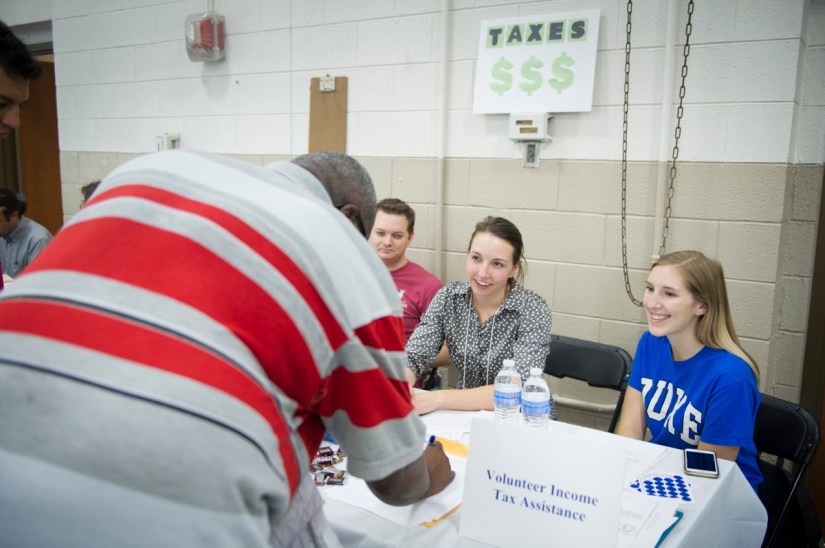
She was one of 16 Duke Law students from the Veterans Assistance Project and the Volunteer Income Tax Assistance (VITA) program who attended the Bull City Stand Down on Sept. 16 to help veterans and other under-served Triangle residents with tax and benefits matters, or to update receive, or correct their military records. More than 320 veterans — many of them homeless or financially struggling — attended the annual event at Durham’s National Guard Armory to access numerous services such as eye examinations, vaccines, and haircuts, as well as legal help.

It was Cole’s third time volunteering at the Stand Down. “This event, every year, puts all of those service providers in one place and coordinates transportation to make sure that a lot of veterans can get here and get a lot of bang for their buck by being able to talk to a lot of service providers that could potentially offer them things they need but might not necessarily know about,,” said Cole, whose family’s military ties led her to join the Veterans Assistance Project as soon as she arrived at Duke Law. “
This is how the Veterans Assistance Project gets most of its clients.”

VITA volunteer Jordan Lamothe ’17 helped clients sort out an array of tax problems. “Some people haven’t filed returns for four or five years and they don’t even know where to start,” he said. “A lot of people are trying to put their lives back together after going through tough times, trying to get to a good place financially, but they’re hit with a huge tax bill and they don’t know what to do.” His goal, he said, was to help the individuals he worked with to understand their taxes and connect them to resources that can help them in the future.

“We don’t want them to have to worry,” he said. “If they owe large amounts, we give them information about how they can talk to the IRS to set up a payment plan so that going forward they can feel more comfortable.”

Leslie Lee, a Durham resident in need of tax assistance, said she appreciated Lamothe’s help. “I feel relieved,” she said. “It was a great service and it was free.”

Precious Sampson, who spent 10 years in the U.S. Army, asked for information about veterans’ benefits when she stopped by the Duke Law table. Recently laid off from a teaching job, she wanted to know about the services they offered. “I’ve actually never used my veterans’ benefits, so I wanted to see what was available to me at this juncture in my life.”

Director of Public Interest and Pro Bono Kim Burrucker, one of the key Stand Down organizers, helped train and supervise the student volunteers, along with Stella Boswell, assistant dean of Public Interest and Career Development. “By participating in this and similar events, students learn valuable legal and interpersonal skills while at the same time providing much needed services to our military veterans and other under-served persons.”

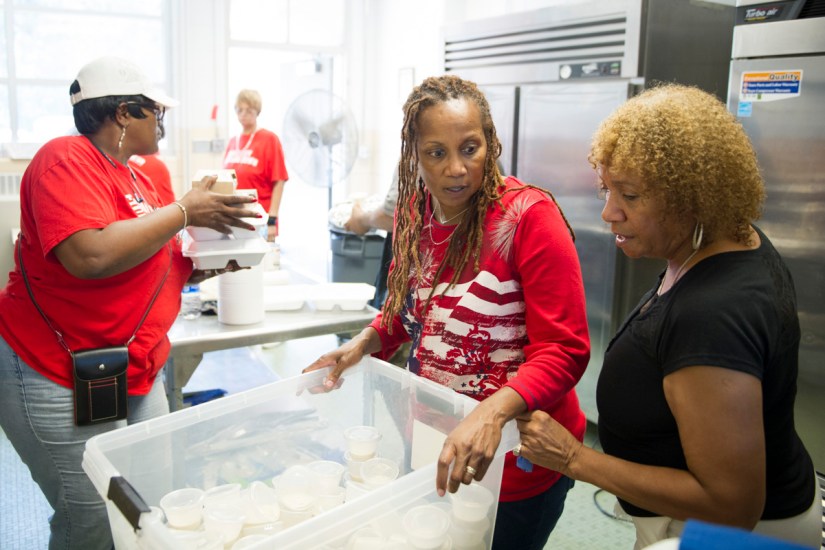
130216_bull_city_stand_down018Director of Public Interest and Pro Bono Kim Burrucker assists volunteers prepare lunch for attendees at the Bull City Stand Down.
Ric Stubbs ’17 focused on helping veterans clean up and access their service records at the Stand Down. “It’s the key to accessing any and all benefits,” said Stubbs, whose parents are both Navy veterans and who hopes to join the Navy JAG Corps after graduation. “We can’t solve all the world’s problems, or the access to justice gap in one go, but veterans [issues] is a pretty worthy place to start,” Stubbs said. “[These are] people who have gone above and beyond and done a lot to earn those benefits, to earn that promise.”

Stories

Anna Johns ’16

With her JD in hand and nearing the finish line on her PhD in history, Anna Johns finds it hard to believe that she once planned to study medicine.

She entered Wellesley College on a pre-med track, intending to follow her mother into medicine. But after taking her first history course, Johns decided to switch gears. “It was Bread and Salt: An Introduction to Russian History, and I was just in love,” Johns says. “I pretended to be pre-med for one more semester. I took chemistry, but I decided my heart just wasn’t in it.”

The native of Birmingham, Ala., graduated with a bachelor’s degree in history and French cultural studies in 2009, but found it impossible to land a job. “It was a terrible time to graduate from college because the U.S. economy was a mess. I felt really sheepish about moving home without a job.”

At that point, she had no interest whatsoever in the practice of law, but her father persuaded her to interview with one of his former law partners for a position at Maynard, Cooper & Gale. She was hired as a paralegal, and that position furthered her passion for research and laid the foundation for her career.

Under the mentorship of a former justice of the Alabama Supreme Court, Johns worked with a team defending the state of Alabama in a class-action lawsuit brought on behalf of public school children. The plaintiffs alleged that the state property-tax system had been put in place with a racially discriminatory intent in order to deprive black school children of an equal education. In addition to participating in drafting the state’s motion for summary judgment, Johns researched property tax laws at the state archives, looking for evidence supporting the plaintiffs’ claim of racially discriminatory intent in the drafting of the state’s property-tax laws.

“I never found it — which made me feel better about my home state — and the state won,” Johns says. But spending time mired in information about poor educational outcomes of Alabama kids, especially in the poorest counties across the state, sparked her interest in Teach For America, in spite of her longer-term plan to go to law school.

“The kids didn’t win,” she says. “I felt like the substance of what I was doing at the law firm had a lot to do with education, and that forced me to confront the extremely unequal access to a good education in America.”

Johns taught fourth and fifth grades, respectively, in San Antonio, Texas, for two years. She says she would have stayed teaching longer, had she not been admitted both to Duke Law (her first choice) and to the university’s PhD program in history (also her first choice). “It took that to tear me away from my kiddos after my second year.”

The James B. Duke Scholar spent her first year at Duke laying the groundwork for her PhD, happily “deep in the history mud.” She then took a leave of absence to focus solely on law. “It was awesome to just be a 1L,” she says. “I got to build friendships and put down roots, which I don’t think I would’ve been able to do if I had tried to do both at the same time.” That’s exactly what she has done for the past yearand- a-half. “Each semester was the craziest semester I’d ever had, only to be topped by the semester that was coming just down the line,” she says of juggling course loads and extracurriculars for both programs. At Duke Law Johns has served as president of the Moot Court Board, articles editor for Duke Law Journal, and co-president of the Volunteer Income Tax Assistance program, which prepares tax returns for low-income Durham residents.

Duke University’s Bass Connections initiative allowed Johns to advance her interdisciplinary interests by serving as graduate student co-chair for the initiative’s Student Advisory Council and working on a project examining retrospective regulatory review headed by Associate Professor of History and Public Policy Edward Balleisen. She also served as as Balleisen’s teaching assistant for his class, The Modern Regulatory State. Balleisen, Duke’s vice provost for Interdisciplinary Studies, says he admires Johns’ poise, maturity, and ability to apply her teaching background in structuring group activities for undergraduates. “She’s unbelievably articulate, has very wide interests, and has the ability to make connections across very different domains,” he says. “She’s taken on two grueling, challenging fields of study. I’ve seen her assimilate those two different bodies of knowledge.”

Johns says she began to appreciate and was able to better understand just how those different bodies of knowledge connect during her second year of law school when she took both an international law course with Laurence Helfer, the Harry R. Chadwick, Sr. Professor of Law, and a graduate-level course on regulation and political economy. At one point, discussion in both classes turned to the collapse of a commercial building in Bangladesh. “In Professor Helfer’s class, we were talking about international trade flows and, in the wake of the Rana Plaza disaster, corporate actions that try to address worker safety issues in Bangladeshi factories,” she recalls. “And then in my history class we were talking broadly about corporate involvement in creating public policy. I started seeing all of these connections between the two different programs. The approaches are different, but the problems are similar.”

She is highlighting those connections in her PhD dissertation, which expands on an independent study with Professor Thomas Metzloff on the history of consumer class actions and how they have been used as tools for consumer protection. After spending the summer of 2016 as a summer associate for Williams & Connolly in Washington, D.C., Johns will return to Duke “writing with ferocity” to finish her PhD. Johns will then clerk first for Judge Allyson Duncan ’75 on the U.S. Court of Appeals for the Fourth Circuit in Raleigh and then for Judge John D. Bates of the U.S. District Court for the District of Columbia.

Stories

Making connections: 1L Blueprint for Success

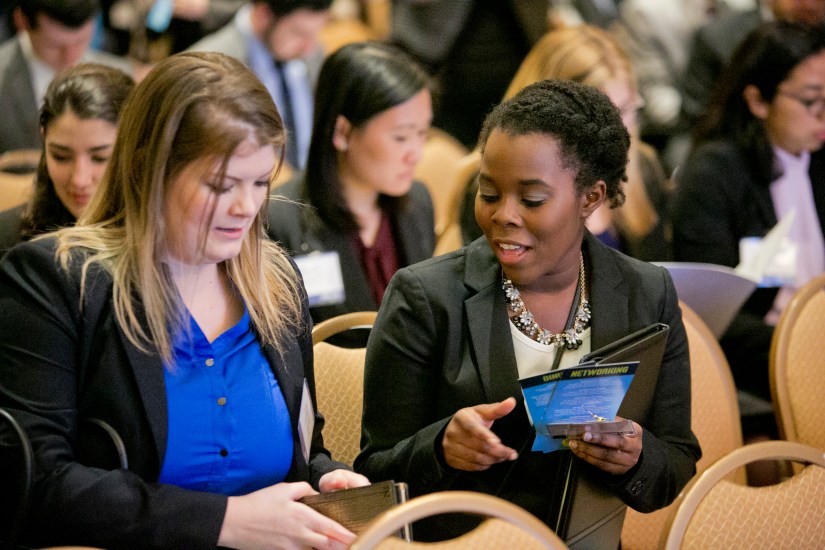
029116_blueprint_success013First-year students got a headstart on planning their careers with the annual 1L Blueprint for Success event sponsored by the Career & Professional Development Center (CPDC). More than 200 students and over 100 employers gathered at the Durham Convention Center for the March 22 event.

Students received a crash course on business etiquette and networking from Mary Crane, author of the “100 Things You Need to Know” book series. Crane’s advice ranged from which hand to keep one’s drink in (the left so you can shake hands with your right) to how to establish meaningful relationships with colleagues (get to know co-workers over lunch, or demonstrate an ability to play well with others by joining the office softball team).

Afterwards, students funneled into the main event space and where they were greeted by prospective employers, received business cards, and asked questions about the organizations and practice areas.

The 58 firms and organizations represented at Blueprint included first-time participant, Morrison & Foerster LLP.

“I think it’s really important for the students to get to learn a little bit more about all of the law firms that are going to be on campus in the fall,” said Kai Wilson, attorney recruiting manager for the Washington, D.C. and Virginia offices of Morrison & Foerster. “By talking to the attorneys and recruiters from the various law firms, they can kind of get a feel for the culture, practice areas, and fit and to see if they think they’d be interested in signing up. During fall recruiting, there’s such a limited number of firms that they’ll be able to meet with, so it’s good for them to be able to narrow their choices down.”

Attending Blueprint helped Sara Faber ’18 do just that. Faber, who will spend her 1L summer in Miami at the ACLU of Florida, had the opportunity to connect with a Duke Law graduate in a civil rights organization who does the kind of work she hopes to do after graduation.

“Upon hearing what I want to do and where I want to do it, she immediately put me in touch with someone in Miami,” Faber said. “It was such a generous thing to do for someone she’d just met.” Connecting with attorneys to learn more about their organizations and how to find work was also helpful, Faber said. “They were very open with us.”

Sonia Williams Murphy, counsel at White & Case LLP in Washington, D.C., attended Blueprint for the first time this year. “I thought it was a fantastic networking opportunity for students and employers alike,” she said. “The fact that the employers get to network with one another is an added bonus and makes this event a bit unique.”

Wolfgang Ettengruber LLM ’15 also noted the importance of reaching out to first-year students. The research assistant from the Clifford Chance office in Frankfurt said, “I think it’s good to meet the students early on, get to know them, kind of follow them, and establish a relationship with them to see where they’re going. I think a lot of them can make use of mentoring, just having an idea of what you’re working towards can kind of help you understand how the law firm – that big pond – works.”

Fortunately through Blueprint, students had the opportunity to start establishing those relationships with alums. “I found it really helpful and comforting that a lot of the employers were Duke Law grads,” said Faber. “They were approachable and kind, and it was helpful to have some shared experiences with potential employers.”

For more information on the Career Center’s 1L Blueprint for Success event, including sponsors and participants, please visit https://law.duke.edu/career/blueprint/.