Stories

Preparing for practice: Wintersession 2016

001316_wintersession_0004Four hundred and sixty students spent the last few days of their winter break honing their practical skills during the Law School’s sixth annual Wintersession.

During four days of classes taught by faculty and practitioners – including many alumni – students received hands-on instruction in such areas as litigation strategy, international transactions, investing, and negotiating.

Ron Aizen ’05, counsel at Davis Polk & Wardwell, offered students an introduction to executive compensation in his course of the same name. He focused on the substance of executive compensation law, such as taxes and securities during the first half of the course. During the second half, students participated in a mock negotiation of a CEO employment agreement.

“In addition to giving the students a taste of what an executive compensation attorneys do, I wanted them to gain an appreciation of the distinction between litigation and transactional practice,” said Aizen. “I think it’s one of the most significant decisions that they’ll need to make.”

Partnering on a Wintersession course for the fifth time with Practice and Strategic Development of International Transactions: Investment in Latin America, Stuart Berkson and Jose Meirelles taught students how to take a transaction from start to finish.

Gibbs, who hopes to go on to corporate law after graduation, said Rhee also discussed the importance of developing “soft” skills. “James reminded us that relationships are critical to social and professional satisfaction –that by being open and pleasant to one another, we create happier and more productive environments.”

Stories

Wintersession 2015: Learning, building, and discovering new skills

wintersession 2015Over 400 Duke Law students spent the last few days of their winter break sharpening their practical lawyering skills during the Law School’s fifth annual Wintersession.

During four days of classes taught by faculty and practitioners – including many alumni – students got hands-on instruction in such areas as deposition strategy, drafting discovery requests and motions, and the intellectual property concerns specific to video game creation.

Milan Prodanovic ’16 took a class on the roles and responsibilities of in-house counsel taught by two Atlanta-based alumni: Allen Nelson ’89, executive vice president, general counsel, corporate secretary, and chief administrative officer at Crawford & Company, and Gray McCalley ’79, vice president and general counsel of Printpack Inc., and a member of the Law School’s extended faculty. Prodanovic said the instructors provided first-hand insight into the issues and challenges they face as corporate counsel. “I walked away from the course with a deeper appreciation of the overlap between business and legal issues that general counsels tackle on a daily basis,” he said.

Eugene Lao JD/LLM ’95, vice president and deputy general counsel at DocuSign, taught Lawyering Inside a Global Technology Company along with Michael Samway JD/LLM ’96, the former vice president and deputy general counsel at Yahoo!, where he led the international team.

“I wanted to share with students what I wish I would have known when I was in law school,” said Lao. Wintersession builds on the “great theoretical foundation” students receive at Duke Law, he said, by giving them the time to delve into subjects and skills that will make the difference between just “knowing the law and being a good lawyer.”

Ryan Berger ’17 enjoyed a course designed to offer 1Ls an introduction to the vocabulary and the process of commercial transactions, The Counselor and the Client: The Corporate Context. “The class helped synthesize the business skills I had previously as a finance major in college and skills I have developed in law school to apply them in a corporate law setting,” he said.

Berger looks forward to attending Wintersession as a 2L and recommends it highly. “It allows you to branch out and learn new things and to possibly develop new interests or discover new career paths.”

Stories

Duke Law students organize “die-in”

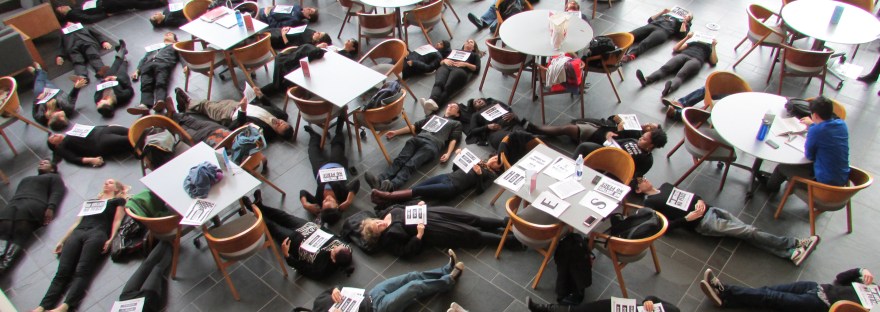
More than 60 members of the Duke Law community held a “die-in” in Star Commons on Dec. 10 to peaceably protest the death of New York resident Eric Garner and other unarmed black and minority individuals killed by police officers in recent years. Holding signs bearing the names of men and women killed, participants, including students, faculty, and staff, laid on the floor in silence for 11 minutes — one minute for each time Garner told police he couldn’t breathe as they continued to forcibly restrain him.

“It’s not like we’re making it up. It’s a real thing that’s happening, so we can’t not talk about it,” said Judea Davis JD/MA ’15, one of the student organizers of the event.

Javon Johnson’s poem, “‘cuz he’s black,” Lauryn Hill’s “Black Rage,” and audio from Garner’s encounter with police on Staten Island, followed by abrupt silence, played over the loud speaker during the demonstration.

Mark Horosko ’15 said the die-in indicated that the Duke Law community is “paying attention” to the deaths of unarmed minority citizens. “We know what’s going on, and we don’t like what’s happening,” he said.

IMG_1834

Continuing the conversation

Davis, who organized the die-in along with 3Ls Gordon Summers, Jana Kovich, and Sarah Tishler, and 2Ls Christine Kim, ’15, Liz Wan’gu, Ana Apostoleris, Peter Lettney, Nichole Davis, and Chris Hood, is planning a panel discussion in the spring semester in order to

keep the dialogue going at Duke Law and beyond. Davis hopes events like this will affirm the Law School’s position within the community as an open forum for discussing social problems. “The students that I’ve talked to believe it’s important to get the community to come to the Law School, because this is ‘our turf’,” she said. “We need to find leaders who are invested in the community — lawyers, police chiefs, and representatives of law enforcement — to sit down to continue to talk about these issues.”

The Black Law Students Association and the Center on Law Race and Politics hosted a September panel discussion on police brutality and race following the shooting of Michael Brown in Ferguson, Mo.

Davis, who is pursuing a master’s degree in history along with her JD, believes in educating others to bring about positive change.

“In America, we don’t do a good job of acknowledging our history or knowing what our history is,” she said. “The Civil Rights movement was hugely successful, but it didn’t erase all the stigmas and assumptions about black people. I think it’s great that President Obama is taking about body cameras, law schools are sending open letters of support to our attorney general and our president, and people are still doing demonstrations. I hope this means the momentum will last.”

Stories

Learning to navigate the world of entrepreneurship: Students hope LLMLE program helps launch their careers

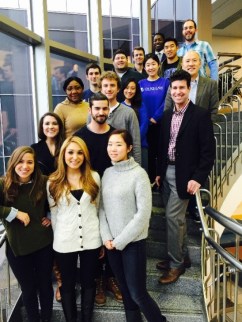
Nicole Simpson says Duke Law’s “startup boot camp” forced her to think like an entrepreneur.

Simpson, who received her JD last May from Temple University’s James E. Beasley School of Law, is one of 17 attorneys pursuing Duke’s LLM in Law and Entrepreneurship (LLMLE).

“We basically went through the same process, in a very condensed version that startups at the American Underground go through,” she said, referring to the downtown Durham incubator for early-stage ventures. “The process helped me conceive of what being an attorney for a startup company would be like.”

Simpson and her classmates spent their first week of the fall semester learning how to craft goals and propose action plans. Working in teams, students used a strategic planning tool, The Business Model Canvas, to draw up ideas for potential key partners, resources, and revenue streams for their startups.

The group has since been immersed in coursework detailing the ins and outs of business strategy, financing, and advising entrepreneurial clients, among other subjects. That’s allowed Simpson to further hone her career aspirations; she plans to pursue entertainment or business law with a focus on mergers and acquisitions or venture capital. She says she appreciates being pushed by Professor Kip Frey ’85, who directs the LLMLE program, to set specific goals.

“He said he didn’t want the program to be just another year of law school,” says Simpson. “I’ve found that to be true.  It’s not at all like the Socratic classroom method of law school. And I learn best through experience – I can’t wait for the spring practicum.” All LLMLE candidates work directly in or for a startup or related operation such as a venture-capital firm, government agency, or law firm in the program’s second semester.

The opportunity to gain experience in the practical aspects of corporate law is also what piqued Will O’Brien’s interest in the LLMLE as he was completing his JD studies at the Chicago-Kent College of Law.

“Through the program I’ve had opportunities to talk with people in the Startup Factory,” he says, referring to another incubator where entrepreneurs can access seed money and mentorship. “Just meeting and hearing about everything other entrepreneurs are doing and coming up with plans and ideas to help them is exciting. It’s really cool to see all of these growing companies and to be around that kind of energy.” It’s also experience that will serve him well when he returns to Chicago to launch a media startup geared toward millennials.

For EJ Johnson, who plans to practice corporate law in New York following his Duke graduation, brainstorming with his classmates is as much an LLMLE highlight as the rigorous coursework.

“They’re what make this class so much fun,” says Johnson, who received his JD in 2013 from Michigan State University, where he also played football as an undergraduate. “Everyone’s not cut from the same quilt. One of my classmates also has his MBA – he’s already started successful businesses. You just learn so much from everyone’s backgrounds. Everyone has an opinion and that always makes for a lively discussion.”

Bryan McGann is the business owner Johnson mentioned. In addition to an MBA from Campbell University, a JD from the University of North Carolina at Chapel Hill, and a PhD from Walden University, he brings a wealth of practical experience to his LLMLE studies:  He is a senior attorney and litigator at Smith Anderson in Raleigh and has achieved entrepreneurial success as the creator of Pill Pockets a pet treat designed to aid medicine delivery. And along with other business ventures, McGann has recently launched a startup focused on developing his recently patented orthopedic brace for post-surgical patients who will benefit from remaining upright in bed.

For McGann, obtaining an LLM in Law and Entrepreneurship at Duke represents his commitment to lifelong learning.

“Being a lawyer is something special, and to be associated with such a great law firm is an honor. Being an entrepreneur is also something special and tremendously gratifying,” he says. “The opportunity to come to Duke and study law and entrepreneurship under this accomplished faculty has rekindled my interest in one day teaching these subjects. My classmates will use their Duke LLMLE to vault themselves into prestigious positions in law and entrepreneurship, but I’m kind of doing it the other way around. In my career, I have been blessed with many opportunities to gain practical experience, and now with the LLMLE from Duke, I look forward to the next challenge, whether in law, teaching, or perhaps politics.”

Stories

Asheville community says “thank you” to Volvo

Volvo Construction Equipment left its mark in the city of Asheville. As a final gesture of gratitude, local schools, churches and community organizations put a full-page “thank you” note in the Asheville Citizen-Times.

From the AB Technical Community College to the YMCA, Volvo employees were involved in a variety of community projects throughout Asheville.

“We built a home with Habitat for Humanity, and during the holiday season we put together Christmas gift boxes and collected coats for families in need,” said Chris Price, Product Marketing & Communication Specialist.

Price says it is a civic duty to give back. “As one of the major employers in the area, Volvo directly affected the people – that made us part of the community, and motivated us to get involved.

Giving back to the community is often a rewarding experience for both the giver and receiver. “Habitat for Humanity was a great experience,” Price says. “We were able to see first-hand the progression an empty lot to a finished home. It was a good feeling to know that I was helping with something worthwhile.”

Winston Leonard retired from Volvo Construction Equipment in 2009. He says he was honored by the community’s gesture. “It was a pleasure to work with a company whose support of and dedication to Asheville earned the respect of the community officials and people.”

Recently, Volvo Construction Equipment was nominated by the YMCA of Western North Carolina for this year’s Outstanding Business in Philanthropy Award. Volvo raised over $187,000 in the last six years for the YMCA. Despite the economic downturn, Volvo stayed committed to contributing to the community and even increased its funding to the YMCA to Platinum Partner level. The annual $15,000 contribution helped the YMCA provide scholarships and financial assistance.

In the nomination letter written by Dana Davis, Director of Fundraising for the YMCA, she describes Volvo’s genuine commitment to philanthropy. “Unlike many businesses with the need to ‘market’ their charitable giving with a level of recognition that overshadows the true purpose of the gift, Volvo’s intention remains true,  and seeks to ensure that their gift is going to those who need it most, and not towards the expense of seeing their name in lights.  Recognition is of course welcome, but their commitment in being a part of the community is demonstrated in their relationships with the organizations they serve.”

Davis says Volvo will be missed in Asheville. “For impact and social responsibility, Volvo Construction Equipment has set the bar high for other businesses in the community to follow its example. Their support and involvement in the community will take years to develop and replace.”